
Understanding the Mercosur–EU Trade Deal and Global Trade Realities

Why Strategic Interpretation Matters Beyond Simplified Narratives
On January 17, 2026, the European Union (EU) and the Mercosur trade bloc — made up of Brazil, Argentina, Paraguay, and Uruguay — signed a landmark trade agreement after more than 25 years of negotiations. This is not just another trade deal; it is poised to create one of the largest free-trade areas in the world, encompassing over 700 million consumers and a combined economic weight approaching a quarter of global GDP. (Trade and Economic Security)
Yet, to understand this agreement’s true significance, leaders must look past simplified narratives of tariff cuts and market access. Instead, it must be interpreted in the broader canvas of global trade realities — rising protectionism, shifting supply chains, geopolitical competition, and complex regulatory ecosystems shaping 21st-century commerce.
Beyond the Headlines: What the Agreement Really Does
At its core, the Mercosur–EU trade deal aims to eliminate tariffs on the vast majority of bilateral trade over a phased timeline. Mercosur will eliminate tariffs on approximately 91% of EU goods over up to 15 years, while the EU will remove duties on 95% of Mercosur products over up to 10 years. (Borderlex)
Such tariff liberalization is significant. For EU exporters, high duties — sometimes as much as 35% on cars and wine — will be phased out, potentially saving around €4 billion annually in customs duties. For Mercosur exporters, easier access to Europe’s high-income consumer markets could boost exports in commodities like beef, ethanol, and soy products. (Trade and Economic Security)
However, the pace of tariff reduction, which can extend over a decade, is intentional — intended to allow affected industries time to adapt and soften transitional shocks. This is not a single event but a long horizon of transformation demanding strategic planning. (Trade and Economic Security)
Global Trade Reality: A World of Fragmentation and Strategic Competition
The backdrop to this trade agreement is an increasingly fragmented global trade environment. Major economies are resorting to industrial policies, tariffs, and export controls to protect strategic sectors. The United States, for example, has layered new tariffs under recent administrations, prompting trading partners to seek diversification and resilience in supply chains. (Slimstock)
Against this backdrop, the EU–Mercosur agreement is both economic and strategic. By strengthening formal trade ties with South America, the EU signals a desire to reduce over-reliance on major powers like China for critical materials and markets. European leaders have explicitly framed this deal as a step toward diversifying trade relationships and reinforcing open markets in an era of rising protectionism. (Sullivam and Cromwell)
More broadly, agreements of this scale are no longer just tariff instruments; they are commercial architecture — shaping where supply chains locate, where investment flows, and how regulatory interoperability evolves.
Trade, Investment, and Market Access: Hard Numbers
The bilateral trade relationship between Mercosur and the EU is significant even without the deal. In 2024, the EU exported approximately €53.3 billion in goods to Mercosur countries, while Mercosur exported €57 billion to the EU — a roughly balanced trade relationship in goods. (Trade and Economic Security)
The EU also accounts for about a quarter of Mercosur’s total trade in services, with European services exports to the bloc reaching €29 billion in 2023. (Trade and Economic Security)
While Mercosur as a group remains a relatively modest share of EU global trade — accounting for about 16.8% of Mercosur’s total trade in 2024 — the volumes are economically meaningful and strategically relevant in sectors like agricultural commodities, machinery, and transport equipment.
The agreement’s supporters point to EU projections that by 2040, the deal could contribute up to €77.6 billion to EU GDP and boost annual exports by roughly 39%, while also supporting hundreds of thousands of jobs. These projections, while long-term, frame the deal as part of broader economic integration rather than a near-term windfall. (European Comission)
Interpreting the Deal in Today’s Trade Landscape
Strategic interpretation of this agreement requires situating it within several broader global trade currents:
1. Rules Matter as Much as Markets
Trade agreements today shape regulatory alignment, digital protocols, public procurement access, and investment protections far beyond tariff schedules. The EU–Mercosur deal includes provisions on sanitary and phytosanitary measures, technical barriers to trade, services, investment liberalization, and intellectual property — all of which set the framework for future cross-border business.
Leaders who focus narrowly on tariff outcomes risk missing how such agreements institutionalize predictability in complex global systems.
2. Trade Networks Are Multipolar
China’s share of Mercosur imports, for example, has risen sharply. In 2025, China supplied roughly 27% of products imported into Mercosur, while the EU accounted for about 19% — a significant shift from earlier decades. This highlights that Mercosur is not economically tethered to Europe alone; it operates within a multipolar trade environment. (Sumauma)
This is why the EU–Mercosur deal is strategically important: it reinforces diversified engagement at a time when global supply chains and trade partnerships are under stress.
3. Implementation Is Political and Procedural
Although signed, the deal still requires ratification by the European Parliament and national legislatures within Mercosur states before it enters into force. Recent legal challenges raised by EU legislators could delay implementation for up to two years, underscoring that politics and law play as decisive a role as economics.
This highlights another lesson: major agreements are not instantaneous market access tools; they are long arc processes requiring strategic preparation and timing.
Why Simplified Narratives Fall Short
It is tempting to reduce this agreement to a story of free trade benefits versus protectionist loss. In reality, its implications extend across multiple dimensions:
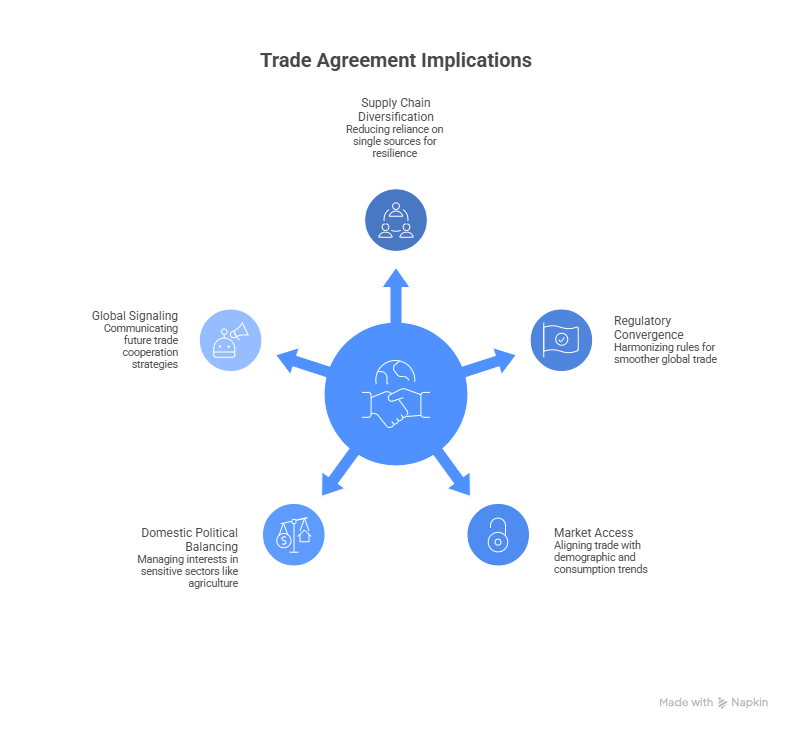
Leaders who frame this — and similar agreements — merely as tariff reduction instruments miss how deeply trade policy now intersects with global strategy, regulatory governance, and long-term competitive positioning.
Conclusion: Strategic Interpretation for Strategic Decisions
The Mercosur–EU trade agreement is, in scale and ambition, one of the most consequential trade deals in the early 21st century. It connects more than 700 million people, touches close to 30% of global GDP, and represents decades of negotiation between continents.
But its real value — for businesses, nations, and global actors — lies not in tariff line graphs but in the strategic opportunities and risks it surfaces in a rapidly evolving global trade system. Interpreting this deal requires connecting it with broader trade fragmentation, supply chain resilience, demand diversification, and regulatory complexity.
Leaders who approach it this way — beyond simplified narratives — will be better equipped to design resilient global strategies in an increasingly interdependent and contested world.


Comments